Gunite Pool Cost in 2026: East Texas Guide
You've been thinking about a pool for a while now.
Maybe it's watching your kids beg to go to a friend's house every weekend in summer. Maybe you're tired of spending thousands on hotels with pools. Or maybe you just want a backyard you'll actually use.
But here's the question that stops most people: How much is this actually going to cost?
If you've been Googling around, you've probably seen everything from $50,000 to $200,000. That range is useless.
You need real numbers for East Texas in 2026.
I'm Doug Johnson, owner of Patriot Pool Co. here in Longview. I've spent 25 years as a mechanical engineer before I got into pool building, and I've built dozens of custom gunite pools across East Texas. Let me walk you through what you'll actually spend and why.
Table of Contents
What You'll Actually Pay in East Texas
The Big Cost Drivers
Breaking Down the Budget
Premium Finishes vs. Standard Plaster
Smart Equipment Worth the Investment
East Texas-Specific Considerations
How to Read a Pool Bid
What to Expect Next
What You'll Actually Pay in East Texas
Here's the straight answer: most custom gunite pools in East Texas run $80,000 to $130,000 in 2026.
That's not a cop-out range. It's real. The difference between $80k and $130k comes down to a few big decisions you'll make about size, features, and finishes.
A basic gunite pool, let's say 14x28 feet, standard plaster, simple rectangle, concrete dec, sits closer to $80,000. Add a spa, upgrade to pebble finish, go bigger, throw in a tanning ledge and LED lights? You're moving toward $130,000.
Both are quality pools. Both will last decades if built right.
The difference is what you want to do in your backyard.
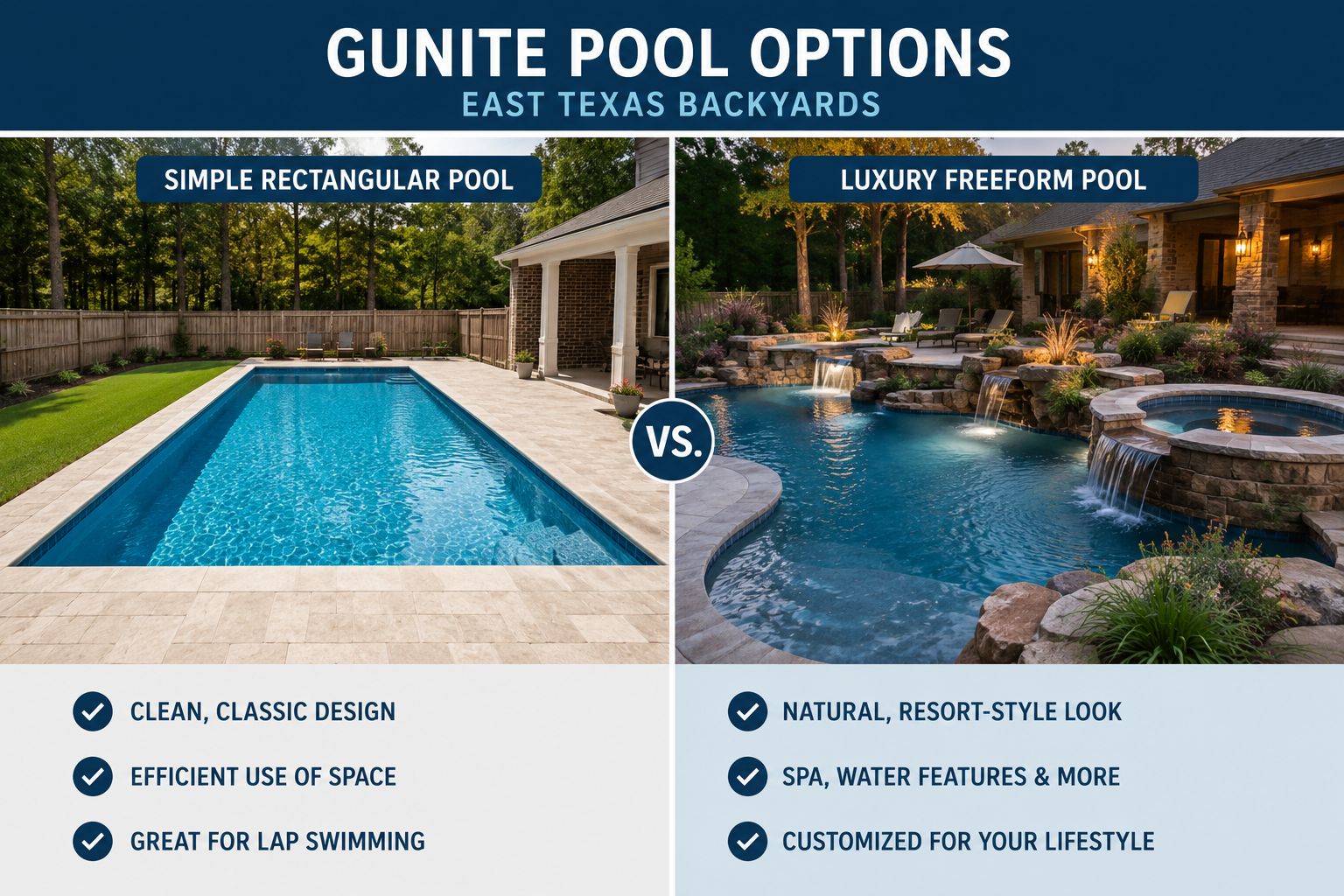
KEY TAKEAWAY: Most East Texas gunite pools cost $80,000–$130,000. Size, features, and finishes drive that range.
The Big Cost Drivers
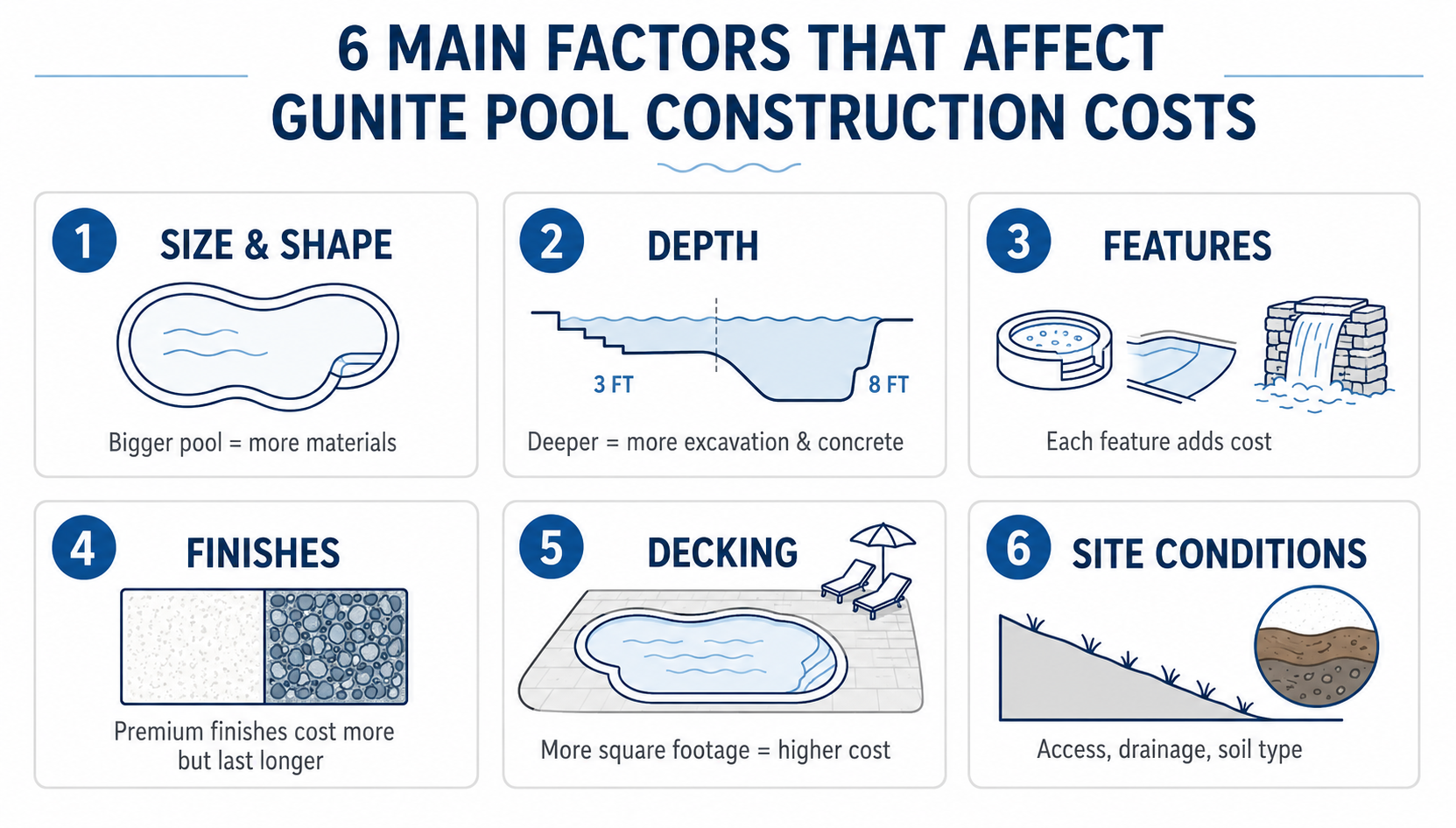
Not all pools cost the same. Here's what pushes the price up or down:
1. Size and Shape
A 14x28 rectangle uses less gunite, less steel, less plumbing, and less decking than a 20x40 freeform with curves and benches. Bigger = more materials = higher cost. Simple math.
2. Depth
A shallow pool (3.5 to 5 feet) costs less than one with a deep end (6 to 8 feet). More depth means more excavation, more concrete, more everything.
3. Features
Want a spa? That's extra plumbing, equipment, and shell work. Tanning ledge? Water features? LED lighting? Each one adds to the bill, but also to how much you'll actually use the pool.
4. Finishes
This is where people get surprised. Standard plaster is cheaper upfront but needs resurfacing every 7-10 years. Premium finishes like pebble or quartz last 15-20+ years and look better longer. We'll break this down more below.
5. Decking
The concrete or pavers around your pool can be as expensive as the pool itself if you go big. A small 3-foot border costs way less than a full outdoor living area with 800 square feet of travertine pavers.
6. Site Conditions
Here in East Texas, we deal with clay-heavy soil. If your yard has drainage issues, steep slopes, or tight access, that adds cost. We have to plan for proper drainage and sometimes bring in extra equipment.
PRO TIP: If budget is tight, start with a solid shell and basic features. You can always add LED lights, upgrade the deck, or add a spa later.
Breaking Down the Budget
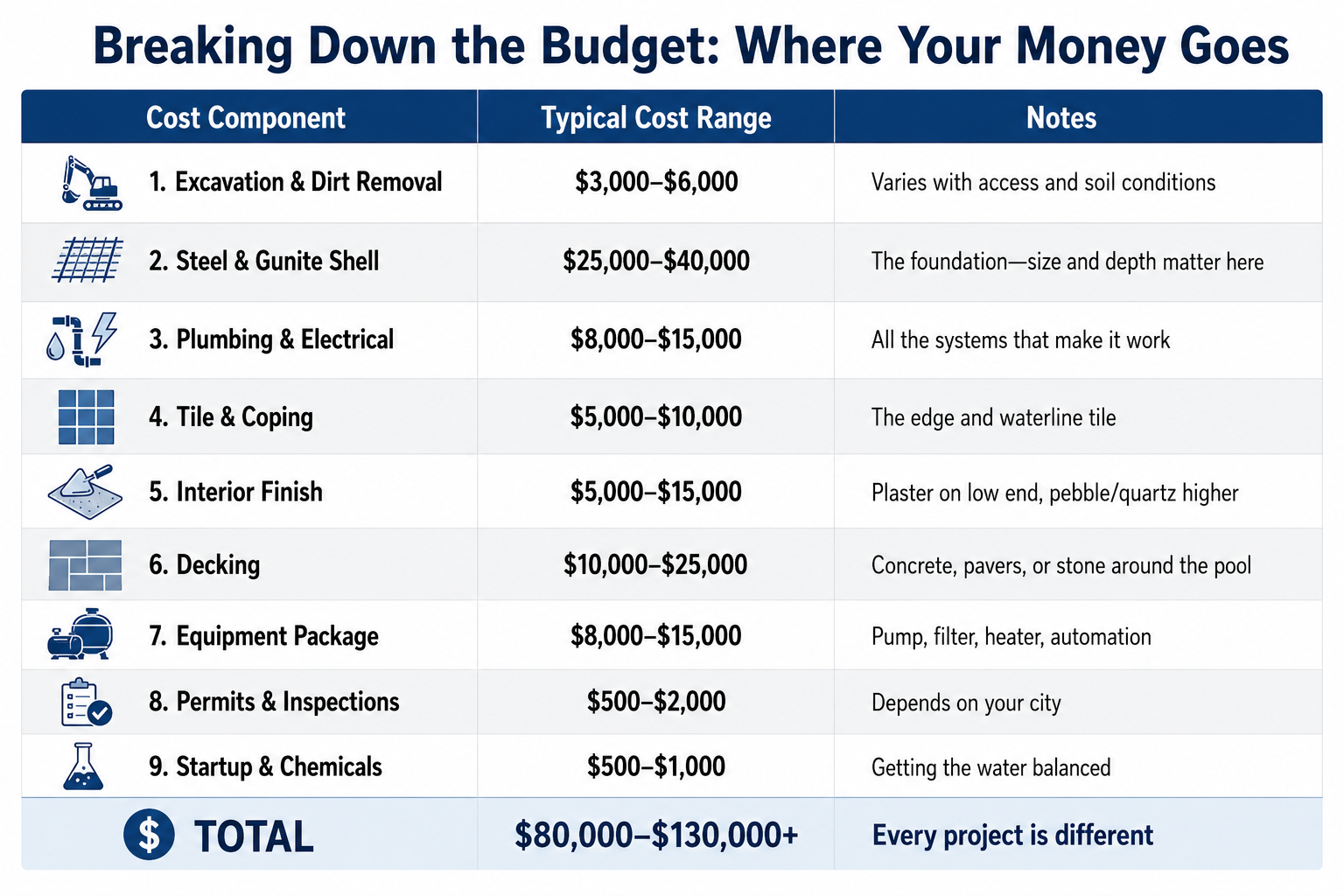
Here's a realistic look at where your money goes on a typical $100,000 gunite pool project.
Every project is different. This gives you a framework to understand where the money goes.
Premium Finishes vs. Standard Plaster
This is one of the biggest decisions you'll make, and it's not just about looks.
Standard Plaster
Cost: $5,000–$8,000
Lifespan: 7-10 years
Pros: Lower upfront cost, smooth surface
Cons: Needs resurfacing sooner, more prone to staining
Pebble or Quartz Finish
Cost: $10,000–$15,000
Lifespan: 15-20+ years
Pros: Lasts way longer, more durable, better color options, hides imperfections
Cons: Higher upfront cost
Here's how I explain it: if you're planning to stay in your home long-term, pebble pays for itself. You avoid a $8,000–$10,000 replaster job 8 years down the road.
If you're building a spec home or planning to move in a few years, standard plaster makes sense.
KEY TAKEAWAY: Pebble costs more upfront but lasts twice as long. It's the better long-term investment for most families.
Smart Equipment Worth the Investment
Your equipment package, pump, filter, heater, automation, affects both upfront cost and how much you spend every month running the pool.
Variable-Speed Pumps
A single-speed pump runs full blast all the time. A variable-speed pump adjusts based on need and can cut your energy use by 50-70%. It costs more upfront ($1,500–$2,500 vs. $800 for single-speed), but it pays for itself in 2-3 years through lower electric bills.
Pool Automation
A smart system lets you control your pump, heater, lights, and spa from your phone. It costs $2,500–$5,000 but makes pool ownership way easier. You can adjust settings from work, set schedules, and catch problems before they become expensive.
In East Texas, where we have long, hot summers, automation and efficient equipment aren't luxuries, they're smart investments.
PRO TIP: Don't cheap out on equipment. A $500 pump that breaks in 3 years costs you more than a $2,000 pump that runs for 15.
East Texas-Specific Considerations
Building a pool in Longview, Tyler, or Marshall isn't the same as building one in Arizona or Florida. Here's what matters here:
Clay Soil
East Texas soil is clay-heavy. That means we have to plan for proper drainage and compaction. If we don't, the shell can shift or crack. This adds to site prep costs but protects your investment.
Access
If your backyard is tight or we can't get equipment back there easily, costs go up. We might need smaller equipment or more hand labor.
Permitting
In city limits, you'll need permits. That adds $500–$2,000 and 1-2 weeks to the timeline. Out in the country? Usually no permits needed.
Weather
We can build most of the year, but heavy rain delays excavation and concrete work. Plan for flexibility in your timeline.
How to Read a Pool Bid
When you get quotes, here's what to look for:
✅ Itemized line items: You should see excavation, steel, gunite, plumbing, electrical, tile, coping, decking, equipment, permits, and startup listed separately.
✅ Finish type specified: Don't accept "interior finish" as a line item. Is it plaster? Pebble? What brand?
✅ Decking square footage: How much deck is included? What material?
✅ Equipment details: What brand pump? Variable-speed or single-speed? What size heater?
✅ Timeline: When does the project start and finish?
✅ Warranty terms: What's covered and for how long?
If a bid doesn't include these details, ask for them. If the contractor won't provide them, walk away.
A $90,000 bid with premium finishes and full automation is a better deal than a $75,000 bid with basic plaster and cheap equipment.
PRO TIP: Get at least 3 bids. Compare line-by-line, not just the bottom number.
What to Expect Next
If you're ready to move forward, here's the typical process:
Free Consultation: We meet at your property, measure, discuss your vision, and give you a ballpark range.
3D Design: I create a custom rendering of your pool so you can see exactly what you're getting.
Detailed Proposal: You get an itemized quote with every cost spelled out.
Construction: 8-12 weeks from excavation to first splash (weather permitting).
Startup & Pool School: We teach you how to maintain your pool and make sure everything works perfectly.
Ready to Get Your Custom Quote?
Every pool is different. Your yard, your vision, your budget, it all matters.
I'm Doug Johnson, and I build custom gunite pools with engineering precision and transparent pricing. No hidden fees. No surprises. Just honest work and clear communication from start to finish.
We serve homeowners across East Texas, Longview, Tyler, Marshall, Kilgore, Lindale, and beyond.
Ready to start planning your pool?
Doug Johnson
Patriot Pool Co.
Longview, Texas